Side loading, sling angles and the limits of a load reading
A load value is useful only when the load path is understood. Separate shackle side loading, sling-leg tension and sensing-axis error before interpreting the display.
LOADSHACKLE / CONCEPT ILLUSTRATION · NOT A DIMENSIONED GAGEOMETRY
45° and 90° derating examples have a limited scope
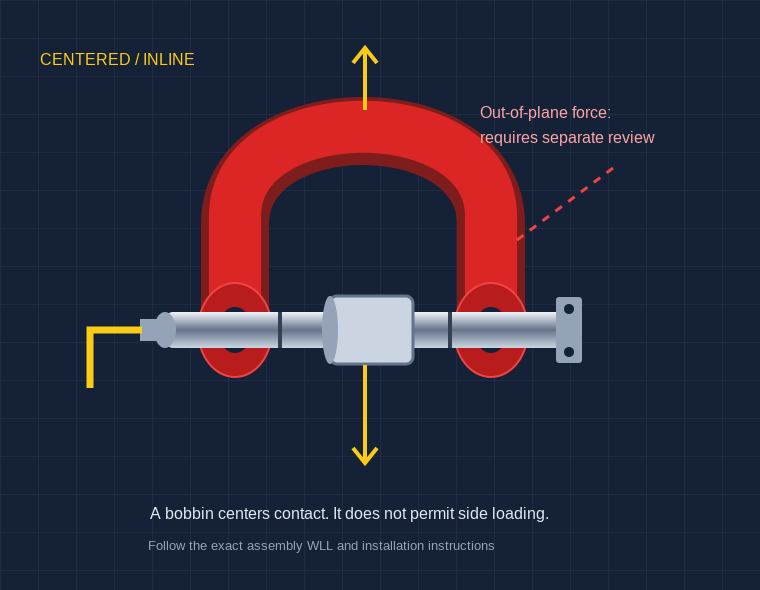
The Crosby ROV manual gives illustrative 100%, 70% and 50% WLL factors at 0–5°, 45° and 90° for specified screw-pin and bolt-type hardware. They are not universal ASME B30.26 values and do not authorize side loading an LSH instrumented shackle. Do not side load round-pin shackles. Without written assembly approval, specify a centered inline load path.
INTEGRATION
A two-leg sling angle is not a shackle side-load angle
For an ideal symmetric static two-leg lift, each leg tension is W / [2 × cos(θ/2)], where θ is the included angle between the legs. Tension rises as the legs spread. This is an educational relationship, not a lift-plan calculator: real load sharing, dynamics, attachment geometry and component limits must be reviewed. An included angle over 60° does not by itself prove failure.
VERIFICATION
Calibration, proof load and MPI answer different questions
Calibration relates a signal to applied load. A proof test follows a defined structural test procedure. MPI inspects suitable ferromagnetic surfaces for indications. None alone establishes fatigue life, corrosion suitability or class acceptance. Witnessing and DNV, ABS or Lloyd’s project requirements must be agreed before manufacture.
Manufacturer instructions govern the actual lift.
The examples above are educational and do not establish allowable side loading, regulatory compliance or fitness for a particular lift.
No. It helps locate the intended bearing zone and reduce wear on the sensing pin. It does not eliminate out-of-plane loading, dynamic overload or installation error. Off-axis loading or a rotated sensing pin may produce a falsely low reading. Do not remove or machine the bobbin to force a fit.
Is electronic monitoring mandatory for every tandem lift?
Requirements depend on the lift plan, jurisdiction and equipment. Use a qualified lifting engineer to define monitoring and independent protective measures. A standard load sensor is not automatically a safety-rated control.
RIGGING KIT & DOCUMENT REQUEST
Build the load path. Then the signal.
Send the geometry, WLL and operating conditions in one request. We confirm the rated assembly, drawing and matched electronics in the quotation.
Selected option allowances$360 USD
Budgetary additions only. Base shackle, electrical matching, witnessing scope, freight and taxes require a quotation.
A configuration request is subject to engineering review. Depth choices and WLL entries are requested specifications.